Michael Coccia

Michael Coccia

PhD Candidate in Finance · University of Mississippi

I am a PhD candidate in Finance at the University of Mississippi, on the job market for 2026–2027. My research is in empirical market microstructure, currently focused on market fragmentation and fractional trading. My job market paper, The Persistence of Market Fragmentation and Liquidity, shows that both the dispersion of trading across venues and liquidity are long memory processes, and that the sign of the relation between them depends on the horizon over which it is measured.

Job Market Paper

The Persistence of Market Fragmentation and Liquidity

Solo-authored

More than half of U.S. equity volume executes away from exchanges that display prices, and the remainder is spread across seventeen exchanges. Whether this dispersion of trading deteriorates market quality is disputed in theory and unresolved in the data. Using a decade of high-frequency data for 1,758 highly traded stocks, I document that both the allocation of a stock's trading across venues and its liquidity are long memory processes with common components. Previous econometric specifications do not accurately identify the relation between fragmentation and liquidity given these properties. I find that competition among lit exchanges is associated with tighter spreads at short horizons and wider spreads at longer horizons, with deeper books at every horizon. A stock's order flow migration off-exchange is associated with wider lit spreads and thinner lit depth at every horizon, while market-wide off-exchange migration is associated with deeper books.
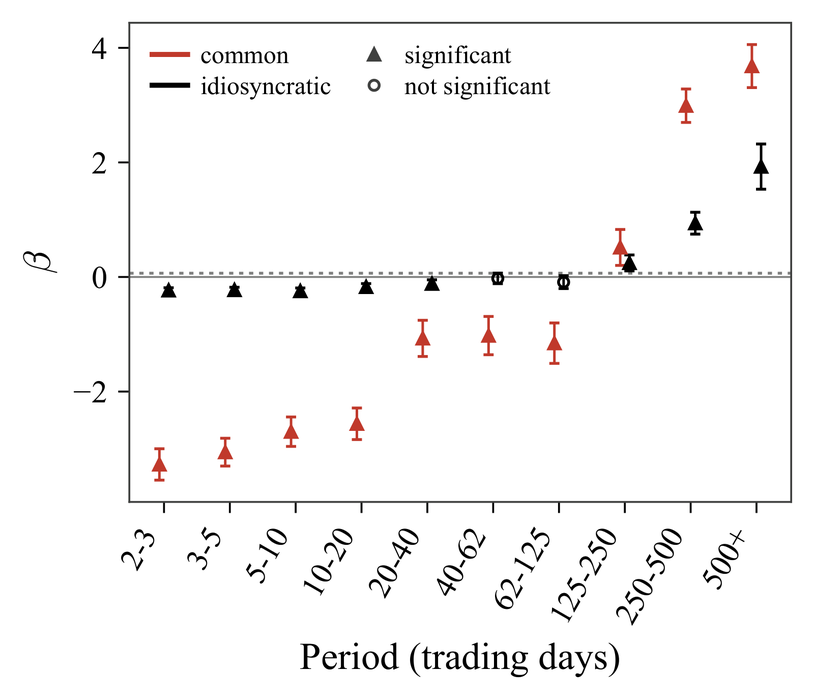
Coefficients on lit fragmentation by frequency band, split into common and idiosyncratic components
Effective spreads against lit fragmentation, by horizon, split into common (red) and idiosyncratic (black) components.

Research

Working Papers

  1. Are Fractional Share Trades Informative?

    with Robert Battalio and Robert A. Van Ness · SSRN working paper, September 2026
    Semifinalist, Best Paper Award (Market Microstructure), 2026 FMA Annual Meeting

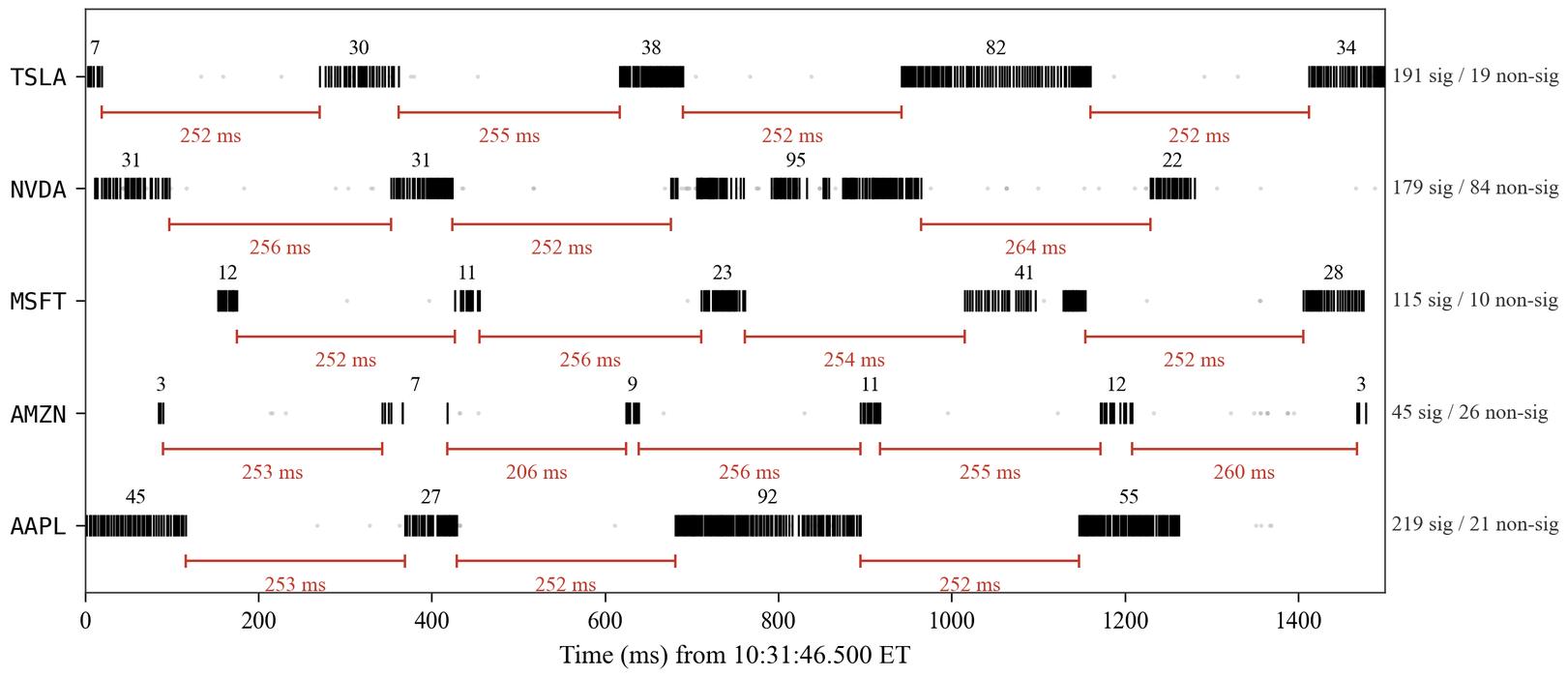
    Recent literature suggests coordinated fractional share trading impacts stock prices. We provide evidence that at least one retail broker systematically executes fractional share orders in batches on a daily basis between 2023 and 2024. For example, during a 5000-millisecond time interval on March 7, 2024, over 65,000 inferred fractional share trades execute in Tesla. We construct a methodology to systematically identify these ‘bursts’ of inferred fractional share trades and use them to investigate whether the batched execution of fractional share orders has price impact. Despite the fact that over 93% of the inferred fractional share trades in bursts are buyer-initiated, both univariate and multivariate analyses indicate that bursts of inferred fractional share trades do not impact underlying security prices.

    Millisecond timeline of burst signature trades in five stocks
    Burst trades in five stocks over 1.5 seconds. Bursts recur on a 252 millisecond cycle.
  2. Crumbs on the Tape: Examining Fractional Trading

    with Robert A. Van Ness · SSRN working paper, July 2026

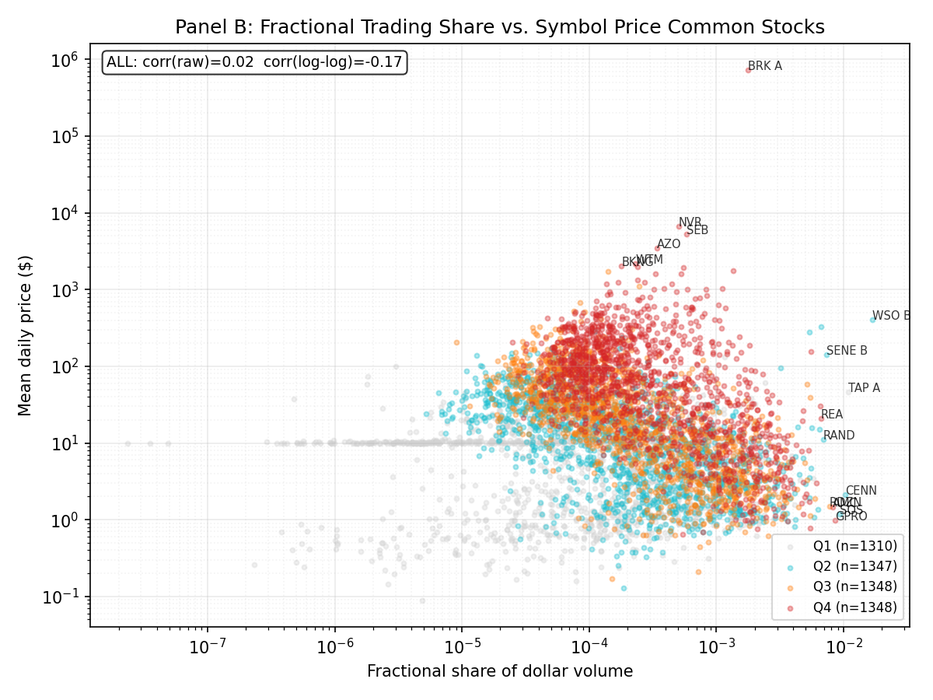
    A February 2026 FINRA reporting change requires fractional-share trades in U.S. equities to print to the consolidated tape at their native size, making a slice of retail activity directly observable. We motivate fractional prints on the tape as a proxy for retail activity and assemble the first census of fractional trades reported to the consolidated tape. Fractional trades are executed by retail brokers, track Rule 605 wholesaler and BJZZ retail benchmarks across the cross-section, and rise with r/wallstreetbets attention. Roughly 54% of common-stock fractional trades are not identified by the BJZZ sub-penny classifier.

    Fractional share of dollar volume against mean daily price for common stocks
    Fractional share of dollar volume against price, by volume quartile.
  3. Algorithmic Trading and Information Dynamics Around Unscheduled Corporate Events

    with Kathleen Fuller and Robert A. Van Ness · SSRN working paper, May 2026

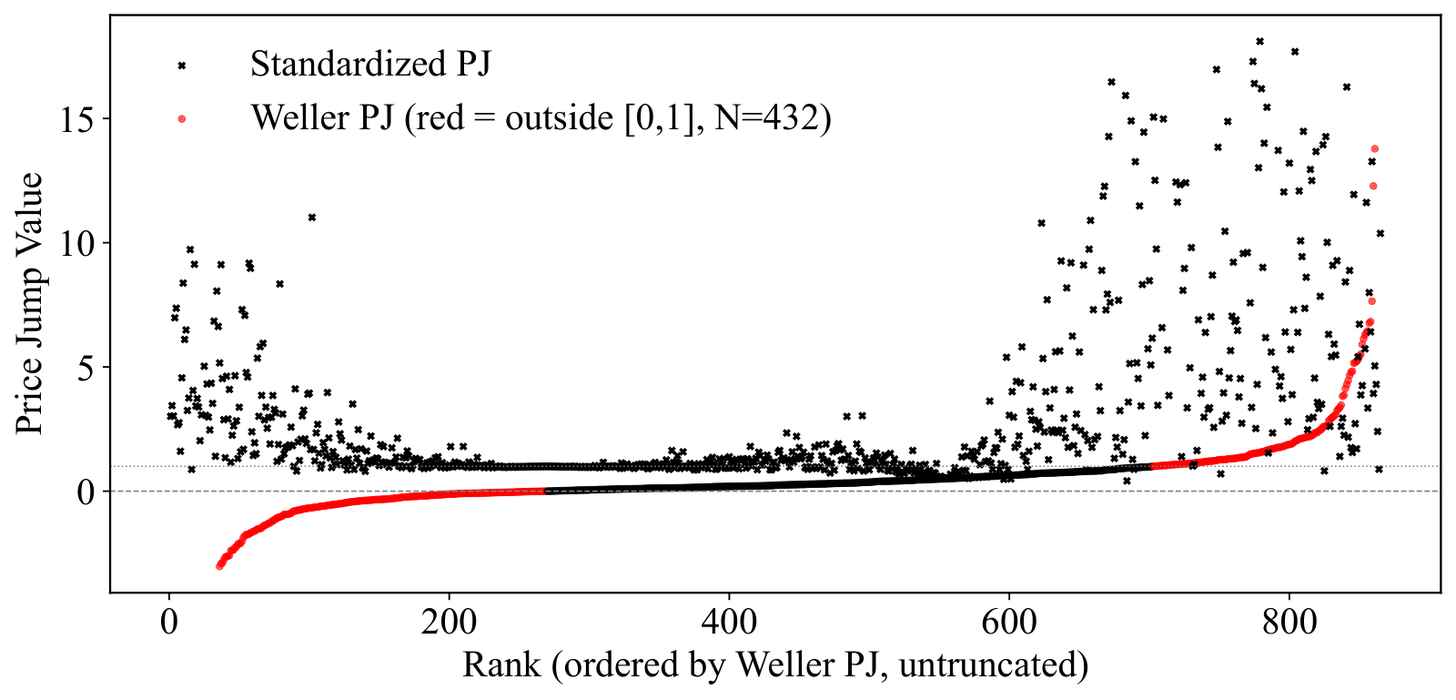
    Prior work establishes that algorithmic trading (AT) deters information acquisition around scheduled events, but whether this extends to unscheduled corporate events is unknown. Using a sample of unexpected special dividend announcements, we find that abnormal AT activity widens pre-announcement informational gaps. To measure the informational asymmetries, we develop a standardized price-jump measure that preserves over 50% of observations that would be discarded under prior approaches. Aggregate AT activity declines for roughly 20 trading days following special dividend announcements — longer than around regular dividend benchmarks — suggesting AT strategies profit from information asymmetry rather than information processing.

    Events ranked by Weller's price jump ratio with the standardized measure overlaid
    Events ranked by Weller's price jump ratio, with the standardized measure overlaid.

Conference Presentations

Teaching

Instructor of record at the University of Mississippi across seven terms, with a mean student rating of roughly 4.4/5. Courses: Business Finance I (FIN 331) and Intermediate Financial Management (FIN 338).

Curriculum Vitae

Download CV (PDF)

Honors & Awards

Service

Contact

Email

macoccia@olemiss.edu

Office

School of Business Administration
University of Mississippi
Oxford, MS

Elsewhere

Google Scholar
LinkedIn
Curriculum Vitae

References

Robert A. Van Ness · Bonnie Van Ness · Kathleen Fuller (University of Mississippi) · Robert Battalio (University of Notre Dame). Full contact details on my CV.